
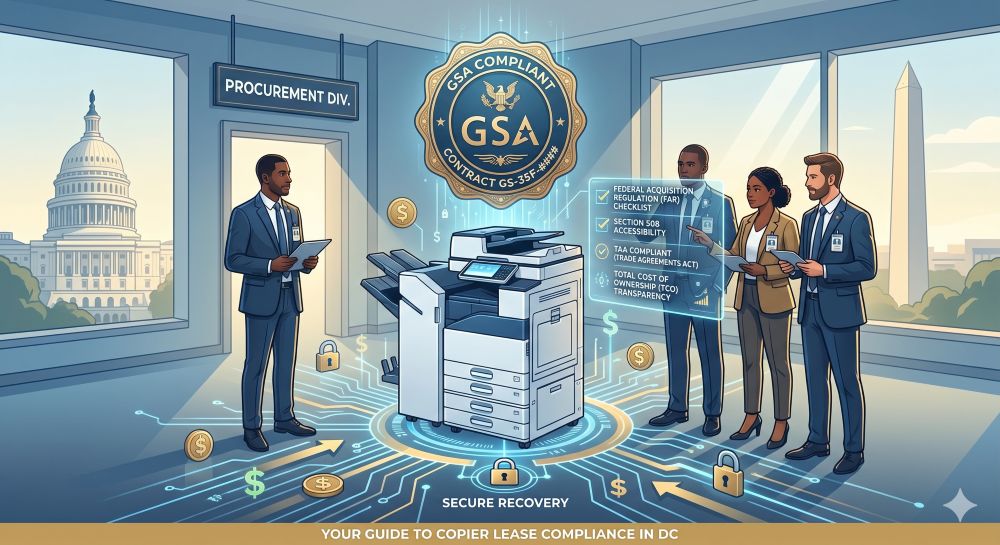
For procurement officers in the District, securing a copier lease in Washington requires more than just comparing monthly rates. Navigating the Federal Acquisition Regulation (FAR) and ensuring GSA Schedule compliance is critical to avoiding contractual pitfalls and ensuring audit
readiness.
- Verify Contractor Eligibility
Before signing any agreement, ensure the vendor holds a valid GSA Multiple Award Schedule (MAS). Under Category 4.4 (Office Management), contractors must demonstrate financial stability and a track record of past performance. Dealing with a GSA-approved vendor streamlines the “fair and reasonable” price determination process. - Section 508 and TAA Compliance
In the federal space, equipment must be accessible. All MFPs must meet Section 508 standards for users with disabilities. Additionally, ensure all hardware is Trade Agreements Act (TAA) compliant, meaning the product was manufactured in the U.S. or a designated country—a
common sticking point in high-security DC agencies. - Security & Data Sanitization
Federal regulations demand strict data security. When finalizing a copier lease in Washington, your contract should explicitly include:
NIST-compliant hard drive encryption.
Automatic data overwrite features.
End-of-lease hard drive removal or certified destruction services.
Pro Tip: Utilize “Piggybacking” clauses. Many DC-based local government agencies can leverage existing GSA contracts to accelerate the procurement cycle while staying within regulatory bounds.
- Total Cost of Ownership (TCO)
GSA guidelines encourage looking beyond the base lease price. Factor in the cost of consumables (toner, drums), maintenance response times, and energy consumption (Energy Star ratings). A compliant lease should offer transparent pricing with no hidden “overage” surprises that violate budget authorizations.